


Team Leader

Agnès Tissier
Researcher

Ambre Dodard
Engineer

Audrey Limousin
Engineer
Maéva Chrétien
Engineer

Sarah Scaglione
Assistant Engineer

Stéphanie Gon
Researcher
Our team studies the spatio-temporal regulation of structure-specific DNA endonucleases (ESS).
Maintaining genome integrity is essential in all organisms for normal cellular function and accurate propagation of the genome. It relies on elaborate multifactorial DNA repair machineries, which need to be coordinated with genome surveillance and cell cycle control mechanisms. Investigating how the cell precisely implements and orchestrates these repair mechanisms with other fundamental cellular processes is paramount to understanding how tumorigenesis is suppressed.
Structure-specific DNA endonucleases (SSEs) are key players in the maintenance of genome integrity. They act as specialized surgical tools for the processing of a wide array of secondary DNA structures generated during DNA replication, repair and recombination processes as well as during transcription.
However, cleaving DNA bears its own risks for the cell, opening windows of opportunity for the occurrence of potentially dangerous chromosome alterations and rearrangements at the origin of cancer development. The action of structure-specific endonucleases must therefore be tightly coordinated with downstream events that will ensure that the integrity of the chromosome is fully restored. It is also pivotal for the cell to avoid any anarchic action of SSEs.
Our team has had a long-standing interest in dissecting the molecular mechanisms that ensure the spatio-temporal control of structure-specific endonucleases.
Using the yeast Schizosaccharomyces pombe as a model organism, we have identified several pathways controlling the Mus81-Eme1 endonuclease in response to DNA damage and during the cell cycle. These control mechanisms proved to be remarkably elaborate, involving functional interactions between protein phosphorylation and sumoylation.
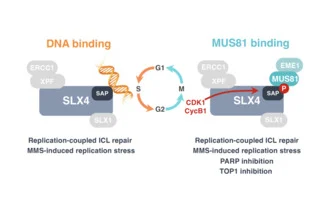
Our team has also pioneered and remained at the forefront of studies on the human SLX4 tumour suppressor, the study of which now constitutes the core of our activity. We and others demonstrated that SLX4 acts as a scaffold that controls and coordinates the XPF-ERCC1, MUS81-EME1 and SLX1 DNA repair and recombination nucleases. Importantly, SLX4 also serves as a scaffold for a number of other factors with key functions in genome maintenance and cell cycle control (Figure 1). Its importance for genome integrity is underlined by the fact that bi-allelic mutations in SLX4 (FANCP) can cause Fanconi anemia, a syndrome associating bone marrow failure with a predisposition to cancer. A fundamental role as a tumor suppressor is also confirmed by the cancer-prone phenotype of mice lacking functional Slx4, and by a growing number of cancer-associated mutations in human SLX4.
We are combining biochemical and structural studies with cell biology, proteomics and genomics in both fundamental and translational research projects to to better understand the multiple functions of SLX4 in maintaining genome integrity and their relevance to cancer biology.

Figure 1: SLX4 is a multifunctional scaffold that fulfils key functions in genome maintenance by interacting with and coordinating the action of a number of important DNA damage response, DNA repair, and cell-cycle control factors. This schematic summarizes findings made by many laboratories including ours.
Its importance for genome integrity is underlined by the fact that certain bi-allelic mutations in SLX4 (FANCP) cause Fanconi anemia, a syndrome associating bone marrow failure with a predisposition to cancer. A fundamental role as a tumor suppressor is also confirmed by the cancer-prone phenotype of mice lacking functional Slx4, and by a growing number of cancer-associated mutations in human SLX4.
We combine biochemical and structural studies with cell biology, proteomics and genomics in basic and translational research projects to better understand the multiple functions of SLX4 in maintaining genome integrity and their relevance to cancer biology.
Team news
featured publications
07/2009
Fekairi S, Scaglione S, Chahwan C, Taylor ER, Tissier A, Coulon S, Dong MQ, Ruse C, Yates JR 3rd, Russell P, Fuchs RP, McGowan CH, Gaillard PHL.
05/2013
Dehé PM, Coulon S, Scaglione S, Shanahan P, Takedachi A, Wohlschlegel JA, Yates JR 3rd, Llorente B, Russell P, Gaillard PH.
01/2015
Guervilly JH, Takedachi A, Naim V, Scaglione S, Chawhan C, Lovera Y, Despras E, Kuraoka I, Kannouche P, Rosselli F, Gaillard PHL.
05/2017
Dehé PM, Gaillard PHL.
05/2020
Takedachi A, Despras E, Scaglione S, Guérois R, Guervilly JH, Blin M, Audebert S, Camoin L, Hasanova Z, Schertzer M, Guille A, Churikov D, Callebaut I, Naim V, Chaffanet M, Borg JP, Bertucci F, Revy P, Birnbaum D, Londoño-Vallejo A, Kannouche PL, Gaillard PHL.
03/2022
Guervilly JH, Blin M, Laureti L, Baudelet E, Audebert S, Gaillard PH.
04/2022
Giaccherini C, Scaglione S, Coulon S, Dehé PM, Gaillard PL.

05/2026
Scaglione S, Gaillard PH.

Like others, they were part of the team. Thank you to all those who have contributed to CRCM's excellence and impact.