



CRCM master 2 campain 2027 is now open !
11 June 2026
FightCancer: A New Inserm Research Facility to Advance Pancreatic Cancer Research
17 June 2026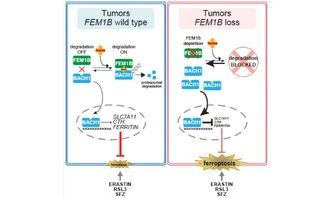
How does a cell sense heme and translate this signal into a stress response?
The Lignitto laboratory discovered that the redox-sensing metabolite heme directly enables the recognition of BACH1 by CRL2–FEM1B. Rather than simply binding BACH1, heme creates the interface required for FEM1B recruitment and BACH1 degradation. Remarkably, this mechanism shares key features with molecular glue degraders, providing some of the first evidence that an endogenous metabolite can directly promote substrate–E3 ligase interactions in mammalian cells.
By controlling BACH1 stability, this pathway regulates ferroptosis sensitivity in lung cancer cells, highlighting a previously unrecognized vulnerability that could be therapeutically exploited.
These findings open new avenues for the development of BACH1-targeting degraders and ferroptosis-based cancer therapies.
Ahmed B, Salaun D, Jordan JB, Daulat A, Pastorello C, Brito T, Yang Y, Josselin E, Byrne D, Betzi S, Pelletier A, Vernerey J, Ferreira L, Castellano R, Audebert S, Camoin L, Pane A, Bechara C, Borg JP, Modesti M, Lignitto L. CRL2FEM1B uses heme to recruit BACH1 for degradation and regulate ferroptosis in lung cancer. Mol Cell. 2026 May 21;86(10):1993-2011.e10.