



Meet Agnès Tissier, new member of the CRCM’s Parity Professional Equality unit
1 June 2026
InScience: CRCM teams meet the general public!
8 June 2026
SLX4 is a scaffold protein pivotal in genome protection mechanisms ranging from homologous recombination and interstrand cross-link (ICL) repair to mechanisms that deal with challenged DNA replication. Many of human SLX4 functions rely on its ability to interact and control the XPF-ERCC1, MUS81-EME1, and SLX1 structure-specific endonucleases.
Interaction with MUS81 relies on the conserved SAP domain of SLX4. Since the same domain in yeast Slx4 orthologs does not interact with Mus81, we investigated whether human SLX4 SAP might have retained some ancestral MUS81-independent functions.
We show that human SLX4 SAP binds DNA with a preference for branched structures such as Holliday junctions. We further discovered that phosphorylation of SLX4 SAP by CDK1, which promotes interaction with MUS81, inhibits DNA binding.
We identified separation of function mutants that impair either DNA or MUS81 binding. Binding to MUS81 is required in response to ICL-inducing agents, methyl methanesulfonate (MMS), TOP1, and PARP inhibition. Instead, DNA binding is required in response to ICL-inducing agents and MMS but not after TOP1 or PARP inhibition.
Our work indicates that phosphorylation by CDK1 acts as a regulatory switch between DNA binding and MUS81-dependent functions of SLX4, to accommodate specific DNA lesions or secondary structures.
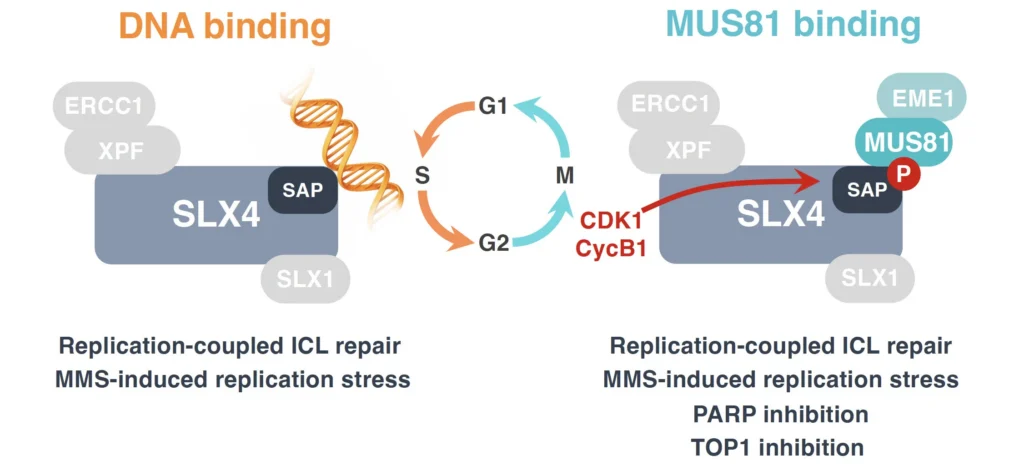
CDK1 phosphorylation switches SLX4 SAP from DNA binding to MUS81 binding.