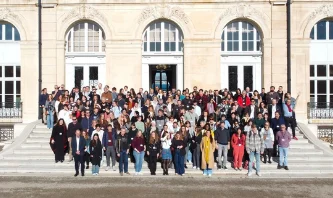



A look back at the CRCM Symposium 2026
5 March 2026
31 PhD positions available at CRCM: discover research opportunities in cancer research
31 March 2026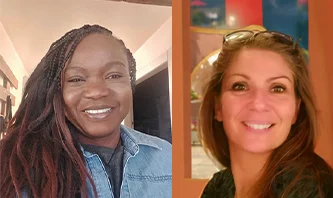
What led you to join the CRCM administrative team?
Julie : “From a very young age, I always dreamed of working in an administration… No, I’m kidding! 😉 To be honest, it was supposed to be a temporary job while I waited to resume my studies. I had just received my BTS (Advanced Vocational Diploma) in Executive Assistance, and I wanted to continue my studies without really knowing what direction to take. I started taking on a series of odd jobs while I figured things out when a former teacher put me in touch with U119 (the predecessor of CRCM) which was looking to replace a former classmate who was leaving her position. At first, it was only for 2 months of temporary work, then another 2 months, followed by a 6-month fixed-term contract… until the permanent IPC contract. It feels like it was yesterday, but I’ve been here for 23 years now, although I have changed seats in the office three times 🙂”
Gladys : “I was part of the team that joined the CRCM following the dissolution of CRO2, the Centre for Research in Biological Oncology and Onco-pharmacology.”
What are your main responsibilities on a daily basis?
Julie : “If you want to place an order, go on a mission, or find out a NACRE code, I’m clearly not the person to talk to. My role is primarily in Human Resources, working in collaboration with and upstream of the HR departments of our various supervisory bodies. There’s also the “Student Life” aspect, including welcoming interns, Individual Monitoring Committees for PhD students, and so on. And when you’re “part of the furniture,” you’re often asked for anything and everything, like: “My Mars bar is stuck in the vending machine, and I really need some chocolate.”
Gladys: “I’m in charge of administrative, financial and HR management. I support the management team in all regulatory, financial and technical aspects of research contracts. I advise and support researchers in setting up their administrative, financial and HR files for calls for research projects from different types of funding bodies: ANR, Associations, Europe, Industry, etc. I check that regulations are correctly applied and, if necessary, propose changes. I check that regulations are properly applied and, if necessary, propose corrective measures in agreement with the Administrative and Financial Director. Lastly, I assist the Administrative Director in carrying out, implementing and monitoring the center’s financial and accounting operations.”
Who do you work with most often?
Julie : “I am fortunate to interact with very different populations. To begin with, the members of the CRCM, Researchers, ITAs, Students. Externally, with the CNRS and Inserm Regional Delegations, the amU and the IPC, or even with interns and students and more marginally with suppliers, representatives and delivery drivers.”
Gladys : “First, with the researchers and technical staff of the center, then with the various departments of our three supervisory bodies, and finally, the funders, service providers, …”
What does a typical day look like for you (if such a thing exists!)?
Julie : “There isn’t really a typical day. From a distance, it might seem predictable and routine, but in reality, I never really know what to expect, and I often have last-minute ‘surprises’ that throw my schedule into disarray. There’s a gap between what I plan and what I’ll actually be able to do. I think it’s inherent to shared services and platforms to be flexible, adaptable, able to disrupt one’s organization, and to prioritize based on the nature of the requests, their level of importance and urgency, and the deadlines to be met. At one time, I used to make ‘TO DO LISTS’ for the next day. I’d arrive full of energy, work all day, and in the evening, the results were really unsatisfactory because not only did I not manage to complete my daily objectives, but the list kept growing. It was disheartening and made me feel guilty. It took me a while, but I finally gave up on ‘TO DO LISTS’.”
Gladys : “I wish there had been one! No matter what you’ve planned for your workday, there are always unforeseen events. It often happens that at the end of the day, the to-do list is still full.”
Is there a misconception about your profession that you would like to deconstruct?
Julie : “Only one? To those who think we’re ‘comfortably settled in our cozy little offices, without any pressure’, I propose a 2-3 day immersion in ‘Rendez-vous en terre inconnue’ mode 😂”
Gladys : “Oh yes! The idea that civil servants are slackers 😄”
Do you work together? On what occasions?
Julie : “Very little, actually. We’re both part of the Administrative team, but we don’t have the same roles. I’d say we act more as intermediaries. For example, before I can initiate recruitment, the financial support has to be available, and that part is handled upstream by Gladys. Conversely, for welcoming interns, I take care of the administrative paperwork, the internship agreement, and then pass it on to Gladys (and the other managers) for processing the stipends.
Gladys : “Yes, regarding the financial aspect of recruitment, Master 2 internships are an example.”
What are the major challenges you are facing?
Julie : “Imagine Shiva! Between the volume and complexity of the files to process, the (very urgent) emergencies and last-minute requests, the days are anything but slow. The door opener, the phone, emails, visitors, constant demands… working two minutes on the same file without interruption is a feat! As for the 35-hour work week, let’s just say it serves mainly as a theoretical basis. My biggest challenge is therefore to manage to move forward efficiently in this whirlwind, meet everyone’s expectations… while remaining calm, available and smiling (I do my best)… as if everything were under control 🙂”
Gladys : “I would say the complexity of administrative procedures. Public institutions talk about “administrative simplification” when implementing new procedures or regulations, but personally, I feel that the result is often quite the opposite. We have to navigate daily waves made up of endless layers of processes that never end. It’s not always easy on a daily basis…”
How has your profession evolved in recent years?
Julie : “It has always maintained its core principles: organizing, coordinating, responding, anticipating… but around this foundation, everything is constantly evolving. The rules change, the procedures become more complex, and the tools of our various supervisory bodies multiply. We hear talk of “administrative simplification,” but on the ground, it’s often more complex and time-consuming than before without necessarily gaining in efficiency. Ultimately, my role has mainly evolved in my ability to adapt to these changes, all while secretly dreaming of a “simplify all this” button!”
Gladys : “Yes, in my opinion, and this is due to the application of these procedures, the multiplication of interlocutors and services for a task that doesn’t necessarily require them. We have more and more responsibilities, but our hands are increasingly tied, so to speak.”
What motivates you in your daily work?
Julie : “It’s primarily about my professional conscience. Even when a task doesn’t seem appealing, I fully commit to it to ensure satisfaction and a sense of accomplishment. Furthermore, collaborating and supporting people involved in cancer research is stimulating. Okay, I’m not saving lives, but indirectly, I’m contributing in my own small way. The relational aspect is also very motivating; exchanging ideas with passionate people, young people, and people from all over the world is a real eye-opener. And the icing on the cake is the friendships you develop with your colleagues.”
Gladys : “This isn’t an easy question, but let’s just say that the concept of public service, the feeling of participating in something bigger by contributing, at my level, to the advancement of research, are driving forces. Without that, who can appreciate this job (I’m talking about management, of course 😉)?”
Coffee or tea during busy days?
Julie : “Coffee! For the taste, the smell, and the essential effects of caffeine. Sometimes I cheat on it with chicory…”
Gladys : “Lots of coffee! But not after 3pm 😊”
Do you sometimes receive requests that are… let’s say unexpected?
Julie : “Yes, but I’m bound by professional secrecy 🤐”
Gladys : “Oh yes, that happens! I would say it’s probably due to some agents not understanding our job and expecting us to solve all their problems.”
What is your greatest satisfaction… and your greatest puzzle?
Julie : “Managing to come back every morning 😉”
Gladys : “When I find solutions to problems for the team, or when I resolve a situation that wasn’t progressing. We have quite a few puzzles, but I wouldn’t call them “beautiful,” and often they’re obstacles related to regulations.”
And outside of the CRCM, what are your activities and interests?
Julie : “Nothing particularly original. I enjoy spending time with those who matter, family and friends, sharing a conversation, a concert, a movie, a walk, a meal, drinks… in short, a convivial moment. Otherwise, I don’t really have any passions, except for travel, but I’m curious and interested in many things.
Gladys : “I enjoy DIY projects, gardening, building things, cooking for my loved ones, in short, nothing too extraordinary.”