

More than 26 articles published in just a few months by CRCM teams!
21 November 2024
Daniel Birnbaum, who passed away on September 21, 2024, was an outstanding researcher, recognized for his remarkable work and unwavering commitment to our institute. His passion for research and dedication inspired many colleagues over the years.
Beyond his scientific achievements, Daniel was also a man who was appreciated and respected by all. He created strong bonds with each and every one of us, generously sharing his knowledge and enthusiasm. His contributions were not limited to research projects, but also extended to the spirit of community and mutual support that he always encouraged within our team.
We will remember him as an exceptional man, whose kindness and intelligence left their mark on our lives. His departure leaves an immense void, but his legacy will live on through the research he carried out and the links he forged among us.
Our thoughts are with his family and loved ones at this difficult time. We have dedicated a space to Daniel, where we have gathered together the many tributes that have been paid to him.

“We received terrible news on Saturday. Our colleague and friend Daniel Birnbaum passed away this weekend. I have taken the liberty of passing on the condolences of the CRCM and IPC staff to his family.
Daniel was my thesis supervisor in 1992-95 and recruited me as an INSERM researcher in his team in 1998. As a doctor and scientist, he made a major contribution to our center, our hospital and beyond.
Daniel left us a legacy of major contributions to our understanding of the molecular anomalies of cancer, and will have marked generations of researchers with his strong personality and his passion for research, in the service of patients. I loved Daniel very much and I am very sad.
Jean-Paul Borg
“How I became part of the OM team without ever having touched a ball.
At the time, the team to which I belonged was in its final months and I needed to find a new base.
Years later, I learned that Daniel, for his part, had sensed the inevitable demise of our team and had decided to make a takeover bid (as he put it!) for the remaining 2 ITAs. Unbeknownst to us, two offices had been reserved for us in his team’s new premises, when the unit was re-created.
The operation began innocently enough with a new proposal for collaboration between the two teams. Then, gradually, the whole of my working time became absorbed by Daniel’s team’s projects. This meant attending a few of their lab meetings. Then all the lab meetings. Informally, and without any further ado, I became a de facto member of the Molecular Oncology team. My office and official affiliation remain unchanged for the time being.
The operation continued unabated when the unit’s re-creation committee visited. In front of a full complement of assessors, team leaders and ITAs, Daniel naturally displayed the organization chart and list of people making up his future team. I was clearly listed by name. This, to my great surprise, as no words had been exchanged. And, once again, this extra step caused no comment, nor any uproar.
The existing collaboration, the team’s dynamism, the projects, the innovative techniques, the presence of a few friendly colleagues, all pointed to the team led by Daniel Birnbaum.
So it was I who closed the deal by making a personal appointment with management to join the Molecular Oncology team.
A successful, wordless and gentle takeover: Bravo l’artiste!
I stayed with the (OM) team for some twenty seasons. I lived through ASXL1, the NGS epic, the rise of Personalized Medicine, and many other adventures.
I am immensely grateful. Thank you, Ô-Daniel-mon-chef!!!”
Nadine Carbuccia

Relaxed waiting with his team.

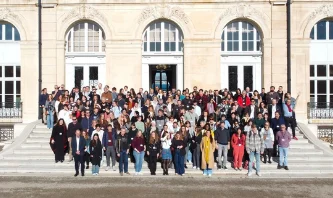
Team 18 photo: the Olé Alé.
Inspired by the soccer fans’ chant “Olé, Olé, Allez”.

Registration. To homogenize the teams, participants were asked their age. At 69, Daniel was the veteran of the meeting.

The human foosball table: A sharp competitor!
“My dear friends, on September 21, 2024, our world of oncology and research lost one of its brightest minds, Daniel, and we are gathered here to pay tribute to him.
His professional life is exemplary: a doctor by training, valedictorian in his first year of medicine, then intern at Paris hospitals, he quickly became interested in cancer research. Thesis at the Marseille Luminy Immunology Center. Then post-doc from 82 to 85 at the prestigious Cold Spring Harbor (USA), in the temple of the first oncogene identifications. In particular, he contributed to the characterization of KRAS, convinced that the identification of these oncogenes and the understanding of their activation could explain the formation of cancers. On his return to France, he joined INSERM, where he became Director of Research in 1991, then Director of Exceptional Research in 2006. His research record is exceptional in terms of publications (>900), scientific awards, scientific advice, training courses, etc.
I knew Daniel well, as he had been my scientific mentor since we first met over 30 years ago.
I met him in ’93 during my medical internship, on the advice of D Maraninchi and P Viens, to do my DEA in the transfer laboratory he had set up at the IPC, one of the very first of its kind in France.
After a quick chat (he always got straight to the point), he agreed to take me on for a year in his laboratory. A laboratory I never left afterwards, in parallel with my clinical activity, and in which I flourished alongside him and his other accomplices here present, such as Max, José, Pascal, Nathalie, and so many others.
Through his courage and generosity, Daniel has spent his life learning and passing on his knowledge to others. In his laboratory, he inspired and trained a large number of doctors, pharmacists and researchers, to whom he passed on the virus of translational research.
A pioneer in cancer genomics, he has enabled the IPC to gain international recognition in the field, notably for breast cancer and leukemia.
He was endowed with a remarkable intelligence that enabled him to grasp the subtlest nuances of situations and come up with enlightened solutions. This intelligence was accompanied by a permanent benevolence that made him a valuable friend and a leader who could always be counted on. He was full of finesse and humor, wisdom, heart, courage and character, class. He was overflowing with enthusiasm, always full of ideas and curiosity, with a single goal: to advance knowledge to cure cancer.
He was passionate about research, a hard worker who was always available and always ready to listen. He knew how to combine rigor and pleasure, showing each and every one of us the importance of pursuing our passions with enthusiasm.
And like the greats, he always remained humble, discreet and human. He didn’t like to show off, let alone talk about himself. His light emanated naturally from his authentic personality. Simplicity was important to him; “it’s the most beautiful garment of greatness”, he used to say.
As well as being a mentor, he quickly became a friend. We shared the same passion for soccer for over 30 years, playing more than 1,000 matches together. Daniel was the team’s official goalkeeper, and what a goalkeeper! with world-class saves that disgusted opposing teams. It has to be said that, just like in research, he put in a hell of a lot of commitment and energy, with muscular exits that were dreaded by the opposing forwards.
With his sudden and all too premature departure, Daniel leaves behind an invaluable scientific and human legacy that we must honour by continuing our commitment to the fight against cancer. Daniel has left us, but his legacy of passion, kindness, enthusiasm and benevolence will live on in each and every one of us. We are even fortunate to still have a little of him in Emilie, his much-loved researcher daughter-in-law, who co-directs Daniel’s laboratory with me.
Daniel, I’m sorry I took so long. You probably would have “trimmed” the text a bit, as you used to do so well in our articles. AND THANK YOU again for everything you’ve given us. We will miss you deeply and you will remain in our hearts forever.”
François Bertucci
“Daniel has been one of the most important people in my career. He has enabled me to accomplish what I set out to do in oncology,
Our training was so different, but for over twenty years we succeeded in building as many interfaces as possible in the field of sporadic or genetic breast cancer. Our natural need to study the immune response was satisfied at the end of our collaboration. Since the announcement of his departure, I’ve been rewinding the film of this adventure, and I’m so lucky to have been able to meet this great humanist.
The sadness of his death is consoled by the measure of the work accomplished with respective positive tenacity.
For his loving family with my gratitude.”
Jocelyne Jacquemier
“Daniel was curious about everything.
Curious about science, of course. This curiosity led him to explore outside the already broad field of oncology, towards other animal models (nematodes), or towards phylogeny and genome evolution.
Curious about art in all its many forms. Daniel had confessed to me that he was bored in medical school (even though he had finished top of his class…), and had enrolled at the Beaux-Arts in parallel. Many knew of his passion for comics; he also loved painting and photography (some of his unsigned works were on display in his office). He was by no means indifferent to music, and I remember rambling discussions on the history of rock in the “cafet” of our old prefab.
Curious about sports too. Soccer, of course! The choice of his team’s name, OM for Molecular Oncology, was no stranger to this passion. But Daniel also played handball (also as a goalkeeper), trekking and climbing.
Curious about everything, Daniel was a passionate man, and deeply fascinating to all those who came into contact with him.”
François Coulier
“I remember the day I defended my thesis, Daniel was among the members of the Jury and the first thing he said was “I really appreciate Marwa because she’s the only one at the CRCM who’s on first-name terms with me… I still feel young”… Daniel was like a grandfather to me when I was away from my family in Tunisia, and he was like a family to me in France. He will always be present in my thoughts and prayers! Rest in peace!
Thanks again for everything!”
Marwa Manaï
“After the solemn tributes, I’d like to tell you a few stories about Daniel.
I met Daniel in 1980 when, coming from Paris to CIML as a thesis student under François Kourilsky, we shared the same laboratory in the 9th East.
Daniel was so passionate about research that he told us he would pay to be a researcher. He was also a student who was always in a hurry, taking our tubes out of the radioactivity meter or stopping our centrifugations because his kinetics manips couldn’t wait – manips he organized around the 1982 World Cup soccer matches, as passionate as he always was about the sport.
He also liked to have fun with friends from the lab, some of whom are still here but others who left far too soon, for example building a plaster statue for Sainte Cloneuse, having ice-cream battles in the CIML corridors or throwing water-filled gloves from the 9th floor to drench buddies passing below.
In 1989, I joined his team at the U119, which became the CRCM, and he was my boss for 15 years, enabling me to work with Olivier and Jean-Paul.
And that’s when I discovered that his favorite room was the darkroom where we developed autoradiography films, because we’d come out with the results all dripping: screens of cDNA libraries, sequences, Southern blots, Northern blots and other Western blots, he didn’t leave it to anyone to change the developer and fixative baths, as evidenced by his fetish blouse stained brown from the developer.
He was generous and always ready to help the community, as when he helped clean up the pet store flooded by the 2000 flood. He was there with us, feet in the water, in the dark and the stench of the cages, making joke after joke and singing to give us courage.
These are just a few of Daniel’s happy memories, among many others, that I won’t forget and that I share with you.”
Sylvie Machetto
“It’s with great emotion and a certain nostalgia that I remember my thesis years under Daniel’s supervision at “Unité 119”. How could I forget his passion for fundamental research, which he considered essential, and his masterly ability to bring it into dialogue with medical research in oncology. I still remember the day when, as was his wont, at the end of the day he went from office to office asking everyone “So … what’s new? And that day, under the microscope, we saw, for the first time, an oncogenic kinase light up at the centrosome. What a surprise and what a shared joy!
Already anticipating the next experiments he might suggest, Daniel immediately set off to pen the first lines of a forthcoming article. His smile and enthusiasm for each of our results carried us through our long hours in the lab. It’s thanks to him, to the confidence he placed in each and every one of us, and to moments like this one, that I chose to continue along the winding paths of fundamental research.
Yes, Daniel was a good listener, treating us as equals while passing on his scientific rigor to each and every one of us. Always in the background, Daniel was present at every stage of my career. His kindness, his simplicity and his advice will continue to guide me in the direction of my research team at the Montpellier Cell Biology Research Center, in my involvement with the Ligue contre le Cancer, for which he was so committed, and in my everyday life. Thank you, Daniel, for leaving an indelible mark on our lives.
Bénédicte Delaval
“Anecdote: it was an internal seminar Thursday and the last presentation was Daniel’s. In the canteen, my student turns to me and confesses in perfect Marseillais: “Oh pétard, la dernière près là, le truc d’immuno, comme j’ai rien capté.”
I nudged him because he hadn’t seen that Daniel was right at our table, hidden by our chef. My signal must not have been clear because he added, “He satelliteed me the guy with the FACS and the markers”.
And Daniel stands up, tray empty, positions himself behind us and says to my student with a little smile: “You know, it wasn’t immuno”.
That was Daniel.”
Pierre-Marie Dehé
“A great researcher has left us. Yes, Daniel Birnbaum was a researcher of the highest calibre.
With a doctorate in medicine and human biology, he had the ideal profile, which has become all too rare. Through the quality of his work, Daniel was quickly recognized by our institute. His decisive character was his strength. Independent, passionate and a great humanist, he was a researcher who found, passed on and trained, an alert watchman.
His application to Inserm for emeritus status reveals much about the man he was. I would like to quote two passages from this application which highlight his philosophy:
“More than 150 people have passed through my laboratory over the years: students, researchers, post-docs, doctors and so on. Most of them have found jobs or been promoted. In the end, along with a few discoveries, that’s what I’m most proud of.
And
“This CV is succinct and incomplete. It doesn’t include any details about valorization, scientific leadership, collaborations, supervision, juries… I haven’t kept any of this information.”
A full CV is required. Daniel didn’t need to make a big deal of it, he knew he was recognized by his institution and his peers. Inserm and his peers knew he played in the Champion League (a nod to this soccer fan).
Yes, Daniel Birnbaum has left his mark on the history of Inserm.
Dominique Nobile
“Dear members of Daniel’s family, dear fellow researchers,
How sad it is to learn on a Sunday evening, via social networks, that a man we knew and loved has gone, brutally.
Many of us knew Daniel as a colleague, an outstanding researcher who had a profound impact on breast cancer research, a brilliant man who was generous with young researchers. We also got to know Daniel from another angle, as a volunteer expert for the League’s National Scientific Council.
Daniel’s most striking personality traits were expressed quite naturally during our working sessions. As a good doctor, his only concern was to pursue the best interests of “good science”, not as an ideal, but with the aim of producing results that could improve patients’ prognosis.
We remember the impassioned discussions, with Daniel tenaciously defending his position, convinced that such a project really had to have a chance of going ahead, sometimes with great ardor, but always with striking good faith.
The League was far from being a source of funding for Daniel; it was a cause and a fight. We still have this memory, at a research symposium in 2017, where he almost expressed regret to the Ligueurs that he hadn’t been able to do more, that there were still women dying of breast cancer. It was very touching.
For Daniel, the League was a network of sincere friends in the committees that remained loyal to him, supporting visionary research for a quarter of a century. We share with you today the deep sadness of the volunteers on these committees who knew Daniel.
With Daniel, a Ligueur is also leaving. We wanted to salute him one last time.
Members of the National Scientific Council of the Ligue contre le cancer”.
Iris Pauporté


Lynda Addou
“My dear friends,
Mon Ami Daniel a rejoint les étoiles….
The emotion is great, the storm is blowing, and one of my roots has slipped away.
L’arbre que je suis vacille…. But paying tribute to him is a duty of friendship.
As we have heard in previous speeches, his professional life was an example to all those who came into contact with him.
For 30 years, I was lucky enough to work alongside him. He taught me so much and gave me so much!
Daniel was much more than an exceptional researcher; he was a mentor, a friend and an inexhaustible source of inspiration in many fields.
To say that Daniel has dedicated his life to cancer research, with unrivalled and uncompromising determination, would be a mild understatement…
Exceptional in many ways…
In his ability to convey his enthusiasm, to share his vision with us.
He had a gift for making the most complex concepts accessible to everyone. I remember that, to explain the need for molecular characterization of a translocation in leukemia, he took and broke two different pencils and pointed to the areas of breakage.
A pioneer in the characterization of oncogenes in cancers as early as his post-doc, he was convinced that the identification of these particular genes and the molecular understanding of their activation could explain the formation of cancers.
Without compromise… he wanted to better understand the disease in order to treat it more effectively.
He will be juggling fundamental research with transfer research. He will work intensively within this vision of collaborative research, with the aim of creating this proximity between researchers and doctors, including pathologists.
Daniel paved the way for this concept, and it was in 2005 that the IPC created the Cancer Biopathology Building. He also supervised the plans to ensure optimal multidisciplinary exchanges.
His scientific contributions were both concrete and exceptional. The work developed within his teams has inspired and will inspire future generations of researchers.
1 – on the molecular characterization of alterations in various types of cancer, from solid tumors to leukemia. Some of these have provided new diagnostic tools or prognostic factors.
2- on the identification and molecular characterization of the potential of cancer stem cells in the mechanisms of recurrence. This is likely to change the future of therapeutic targeting of tumors enriched with cancer stem cells.
3- on precision medicine.
Despite advances, some tumors or leukemias are aggressive and resistant to several lines of conventional treatment. What could we do for these patients? How could we support oncologists in their therapeutic strategies in the face of metastatic disease that kills patients?
As he so aptly put it, “cancer is a complex and heterogeneous disease”… So the breast cancer of Madame Dupont will never be the breast cancer of Madame Durand. So, for each patient, we have to identify their Achilles heel on the basis of genomic analysis. In this way, we have been among the first to develop and implement precision medicine for both solid tumors and leukemia in patients with advanced cancer or refractory leukemia.
4- and finally, the development of new drugs
Thanks to his work, the IPC has gained national and international recognition in the field of cancer genomics. Thank you, Daniel!
As we heard earlier, he was recognized by his peers and won numerous scientific awards.
But Daniel had the humility and generosity of the greats…
Always in the background for team photos, he let us take the spotlight. He used to say, “Without my teams, I’m just a conductor without a musician”…. Between us, we had long understood that his silences composed our harmony….
Always concerned to do the right thing, Daniel will often ask himself, “Is our research useful for the patient?” The knowledge and know-how generated by his teams have always been transferred to the clinic.
He taught us so much and gave us so much!
Many doctors, pharmacists and researchers have travelled with him along the way. They’ve lived a part of the adventure, and flourished.
Committed and passionate, he passed on knowledge and hope, leaving us an extraordinary scientific legacy. Like him, without compromise, let’s stay the course, continuing the fight against disease and drawing inspiration from the values he passed on to us.
Today, like all of you, I am devastated by sadness. But I’m also immensely grateful to have crossed his path. I will long remember his voice, his smile, his kindness and the moments of sharing when his kindness was always offered to me.
At his side, the carefree spirit of our friendship flowed through the hourglass of sacred time, unaware that one day it would end. Of course, selfishly, I’d love to turn that damned hourglass upside down and relive those moments again, unaware of my own finitude.
With his great humanity, he will always shine in my heart and mind like a beacon in the night.
Thank you Daniel… I will miss you terribly.”
Max Chaffanet
We still welcome your memories and testimonials in tribute to Daniel Birnbaum. Don’t hesitate to send them to us to enrich this page of shared memories(communication.crcm@inserm.fr).