

Improving pancreatic cancer detection with AI
6 February 2026
Solidarity run
3 March 2026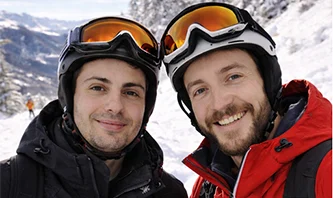
Olivier Castellanet and Jean Monatte, who defended their theses in 2024 and 2025 respectively, are the co-authors of a study published in Molecular Cancer (Multi-omics profiling uncovers immune-molecular clusters with distinct chemo-immunotherapeutic vulnerabilities in a mouse model of triple-negative breast cancer.), devoted to triple-negative breast cancer. A CRCM reporter went to meet them at the Chabanon ski resort.
“TNBC is not a homogeneous group”
Triple-negative breast cancer (TNBC) accounts for around 15% of breast cancers. It is characterised by the absence of three major therapeutic targets (hormone receptors and HER2), which limits the options for targeted therapies.
“TNBC is often referred to as a single subtype. In reality, it is a very heterogeneous category,” explains Olivier.
Some tumours are rich in immune cells, others are not. Some respond to immunotherapy, others are resistant. Hence their hypothesis: can we identify coherent groups of tumours, sharing common immuno-molecular signatures, ‘clusters’, with specific treatment sensitivities?
“A tumour… it’s a bit like a national assembly!”, enthuses Jean.
Multi-omics biology: the molecular prism
To answer this question, the team used a multi-omics approach: analyzing genes, the entire protein spectrum, immune cells, and their associated response to treatments.
“The idea is simple: don’t look at the tumor from a single perspective, but rather cross-reference several layers of information,” explains Jean.
Using a mouse model of TNBC, they identified several clusters, each exhibiting a particular organization of the immune system and a different sensitivity to chemotherapy-immunotherapy combinations.
“The appeal of our study also lies in the fact that these different layers of information are obtained from the same tumors, which reinforces the relevance of combining our generated data!” Olivier enthuses.
The key role of the MMTV-R26Met mouse model
A key element of the project lies in the use of a specific mouse model: the MMTV-R26Met model.
Olivier explains:
“This model allows us to mimic triple-negative breast cancer induced by MET overexpression in the mammary gland.”
Specifically, this model offers several advantages: It spontaneously develops breast tumors. It reproduces strong tumor heterogeneity. It maintains a functional immune system, which is essential for studying responses to immunotherapy.
Olivier adds:
“It’s a particularly interesting model because it reflects the biological diversity we observe in patients. We’re not working with a uniform tumor, but with a population of different tumors, just like in clinical practice.”
When will this be available for patients?
In the article, these identified clusters, validated in mice, are also found in humans. Could we better stratify patients?
“Rather than opposing ‘responders’ and ‘non-responders,’ our study proposes a more structured interpretation of TNBC: biologically coherent subgroups, distinct immune microenvironments, and differentiated therapeutic vulnerabilities that would allow for more targeted clinical studies. To confirm this, we now need to move to clinical trials and evaluate the relevance of these clusters. And that’s no easy task! Let’s remember that research is a long process, and we must be wary of the researcher’s enthusiasm and the false hope it generates,” cautions Jean.
Personal questions
Because science is also about human journeys, the reporter slipped in a few more personal questions to the co-authors.
If you had to explain your project in simple terms to a close friend or family member in one sentence?
Olivier: “A tumor is like a puzzle: each piece is different, and to understand the final picture, you have to put them together one by one. Imagine how difficult it is to finish the puzzle without looking at the pieces.”
Jean: “As I already said, a tumor… it’s a bit like a national assembly!”
What was your “turning point” in this project?
Jean: “Maintaining the immune environment of tumors after successive transplants… because this result has always sparked fruitful conversations about the mechanisms of immune recruitment intrinsic to tumors.”
Olivier: “For me, I would say perhaps when we realized how heterogeneous the immune microenvironment was from one tumor to another in mice. That’s when we understood that we held a key to modeling the different patient profiles by finally looking ‘beyond tumor cells.’ It was a major preclinical hurdle that needed to be overcome for TNBC, especially with the emergence of immunotherapy.”
How many coffees will it take to finish all the different analyses?
Olivier (laughs): “I don’t drink coffee, I don’t need it. The stimulation from a job well done is more than enough for me… (and neurostimulants).”
Jean (laughs): “I’m not as ascetic as Olivier because I do make exceptions. And I’d like to quickly mention the coffee that boosted these analyses: ‘Samad’ coffee (author of the article)… it’s a magician!”
If your study were a movie?
Jean: “Well… I’d say Inception? Actually, our article is written layer by layer of analysis, like a dream within a dream. We start in Figure 2 with immunology, then we go further with proteomics in Figure 3, genomics, etc., and it all intertwines… A bit like in the film where each dream level leads you to a new discovery, but you never quite know where it’s going to take you. We have to send our article to Christopher at the next Cannes Film Festival!”
Olivier: “I’ll be more down-to-earth than Jean: I’d say Shrek! For the famous line about onions: ‘Onions have layers, ogres have layers…’ Our TNBC tumors are the same. We peeled back each layer to see what was hidden there. Going ‘beyond tumor cells’ means not stopping at the onion’s skin, but analyzing the entire ecosystem that revolves around it.” It’s complex, but each “character” is important to the end of the story.
What’s next for you?
Olivier, a PhD in biology specializing in tumor-immune system interactions, is pursuing a Medical Science Liaison position in immunology at Sanofi.
“I want to bridge the gap between preclinical research, therapeutic development, and clinical practice.”
Jean, a pharmacist by training specializing in oncology, is preparing to leave for the United States for a postdoctoral fellowship focused on TNBC in clinical research.
“The next challenge is validation in humans and integration into clinical trials.”
The final word
If you had to summarize the potential impact of your work?
“Impact isn’t just about words. I simply hope we’ve contributed to laying another stone toward precision medicine that is finally a reality for patients,” replies Olivier.
“What’s simple is never true, what isn’t simple is unusable,” concludes Jean (laughs).