


- Cet évènement est passé.
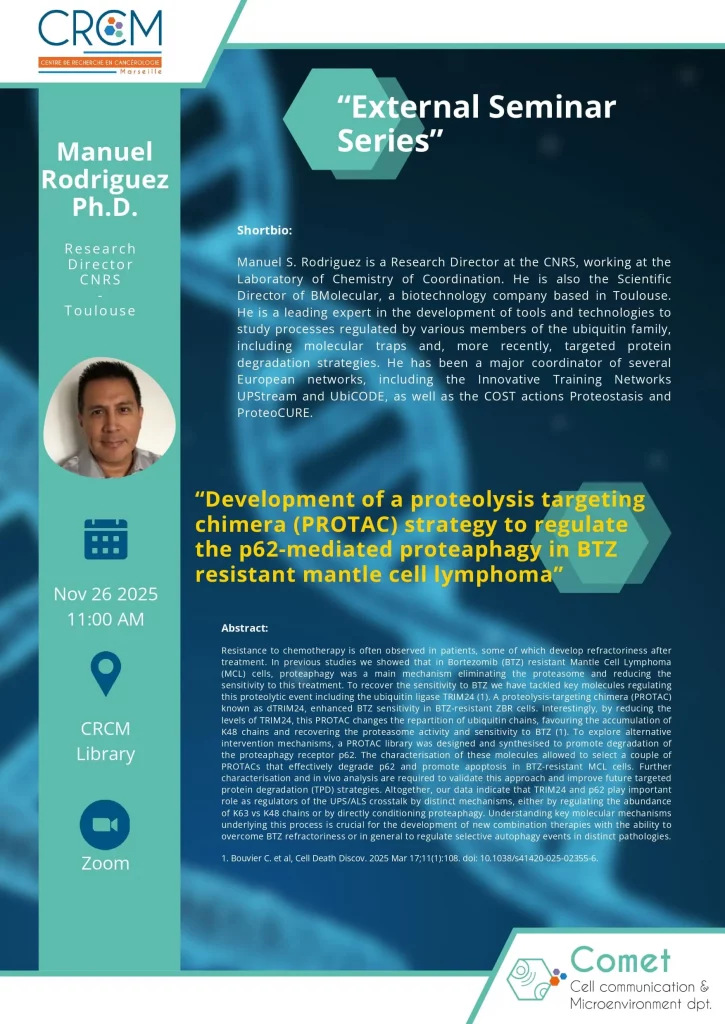
Manuel Rodriguez
26 novembre, 2025 / 11h00 – 12h00
Resistance to chemotherapy is often observed in patients, some of which develop refractoriness after treatment. In previous studies we showed that in Bortezomib (BTZ) resistant Mantle Cell Lymphoma (MCL) cells, proteaphagy was a main mechanism eliminating the proteasome and reducing the sensitivity to this treatment. To recover the sensitivity to BTZ we have tackled key molecules regulating this proteolytic event including the ubiquitin ligase TRIM24 (1). A proteolysis-targeting chimera (PROTAC) known as dTRIM24, enhanced BTZ sensitivity in BTZ-resistant ZBR cells. Interestingly, by reducing the levels of TRIM24, this PROTAC changes the repartition of ubiquitin chains, favouring the accumulation of K48 chains and recovering the proteasome activity and sensitivity to BTZ (1).
To explore alternative intervention mechanisms, a PROTAC library was designed and synthesised to promote degradation of the proteaphagy receptor p62. The characterisation of these molecules allowed to select a couple of PROTACs that effectively degrade p62 and promote apoptosis in BTZ-resistant MCL cells. Further characterisation and in vivo analysis are required to validate this approach and improve future targeted protein degradation (TPD) strategies.
Altogether, our data indicate that TRIM24 and p62 play important role as regulators of the UPS/ALS crosstalk by distinct mechanisms, either by regulating the abundance of K63 vs K48 chains or by directly conditioning proteaphagy.
Understanding key molecular mechanisms underlying this process is crucial for the development of new combination therapies with the ability to overcome BTZ refractoriness or in general to regulate selective autophagy events in distinct pathologies.